
Setting Up a School Physics Lab on a Fixed Budget
Physics · 28 August 2026
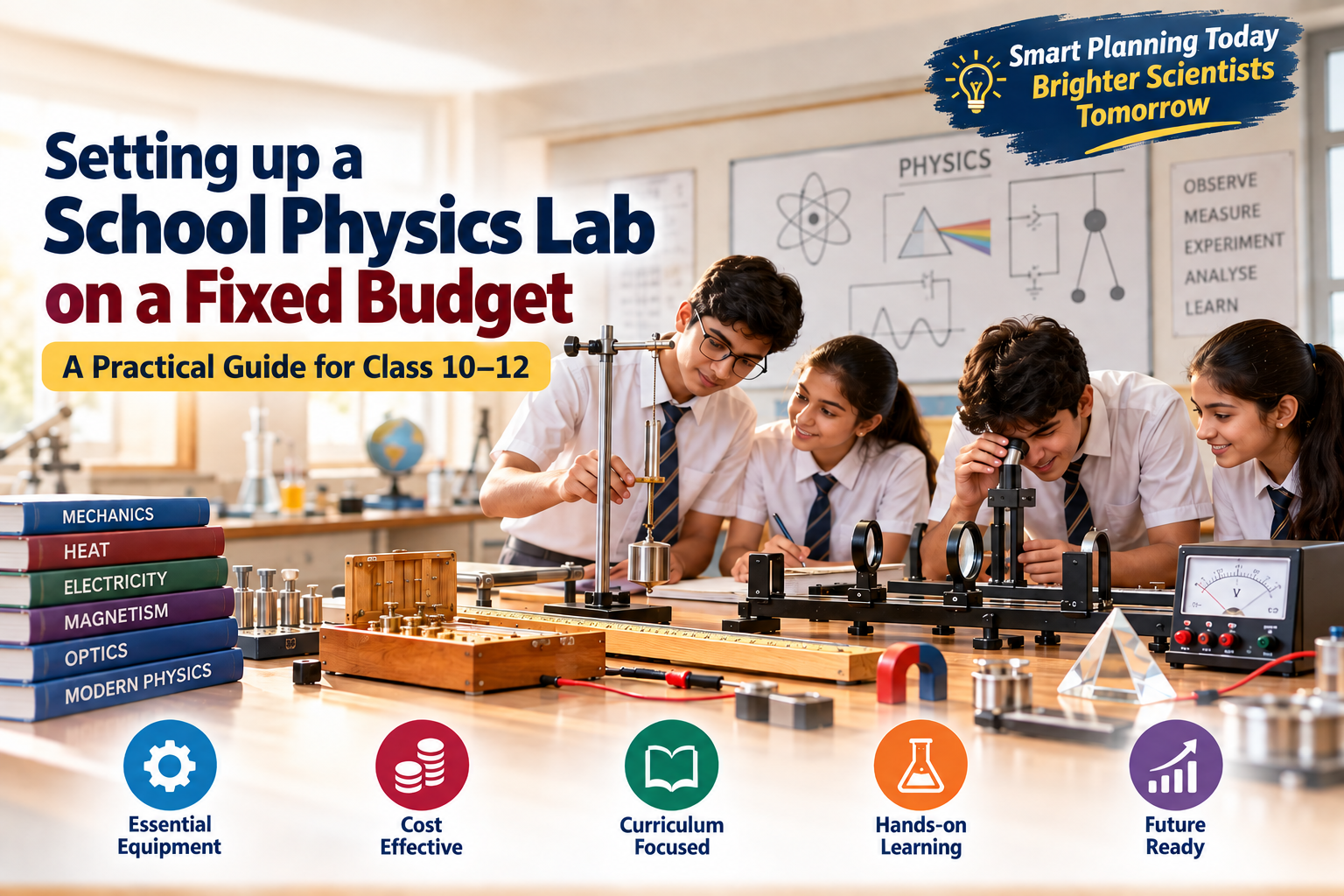
Setting up a school physics laboratory for Classes 10–12 does not require a huge budget. With careful planning, schools can create an effective laboratory by prioritizing syllabus-based equipment, choosing durable and multipurpose apparatus, organizing the lab efficiently, and expanding the equipment gradually. A well-planned physics lab gives students valuable hands-on experience and helps them understand theoretical concepts through practical learning.
A Practical Guide for Class 10–12
A well-equipped physics laboratory is an essential part of science education. For students of Classes 10–12, practical experiments help transform theoretical concepts into real-world understanding. However, schools often have to establish or upgrade their laboratories within a fixed budget.
The good news is that a useful and functional physics laboratory does not necessarily require expensive equipment. With proper planning, schools can build a practical, safe, and engaging physics lab while making the best use of available resources.
1. Start with the Curriculum
The first step is to understand exactly what students need to learn.
Prepare a list of practical experiments and activities prescribed by the relevant CBSE or State Board curriculum for Classes 10–12. Map each experiment to the apparatus required.
Prioritize equipment that is:
Required for regular practical examinations
Used in multiple experiments
Relevant to important syllabus concepts
Suitable for repeated student use
Durable and easy to maintain
Avoid purchasing advanced or specialized equipment at the beginning if it will only be used occasionally.
2. Prioritize Essential Equipment
When working with a fixed budget, focus on equipment that provides maximum educational value.
Mechanics
Depending on the curriculum, commonly required apparatus may include:
Meter scales and measuring instruments
Vernier calipers
Screw gauges
Simple pendulum apparatus
Inclined plane
Pulley systems
Force and motion apparatus
Parallelogram of forces apparatus
Young's modulus apparatus
Heat
Useful equipment may include:
Thermometers
Calorimeters
Specific heat apparatus
Heat conduction and expansion apparatus
Temperature measurement accessories
Electricity & Magnetism
This is one of the most important areas for Classes 10–12.
Consider:
DC power supplies
Galvanometers
Ammeters
Voltmeters
Resistance boxes
Rheostats
Connecting wires
Switches and keys
Magnets
Magnetic field apparatus
Electrical circuit boards
Optics
Essential optical equipment can include:
Optical bench
Convex and concave lenses
Mirrors
Prisms
Lens holders
Mirror holders
Spectrometer
Optical accessories
Modern Physics
Depending on the syllabus and available budget, schools can gradually add apparatus for topics such as:
Photoelectric effect
Semiconductor experiments
Planck's constant
Diodes and transistors
Digital electronics
3. Choose Multipurpose Equipment
One of the smartest ways to control costs is to select equipment that can be used for several experiments.
For example, a good-quality power supply, multimeter, optical bench, resistance box, or set of mechanical accessories can support multiple practical activities.
Instead of buying several low-quality products for individual experiments, consider investing in durable, multipurpose equipment that can be used year after year.
4. Compare Quality, Price and Durability
The cheapest product is not always the most economical choice.
Laboratory equipment is used repeatedly by students, teachers, and laboratory staff. Poor-quality apparatus may require frequent replacement and can ultimately cost more.
Before purchasing, consider:
Build quality
Accuracy
Durability
Ease of operation
Availability of spare parts
Warranty or after-sales support
Manufacturer reputation
Suitability for the prescribed curriculum
Schools should compare quotations from reliable suppliers and select equipment based on overall value rather than price alone.
5. Plan the Laboratory Layout
Good organization can make even a modest laboratory highly effective.
The laboratory should have:
Adequate working tables
Proper lighting and ventilation
Safe electrical points
Storage cabinets
Clearly labelled equipment
Separate areas for delicate instruments
Sufficient space for students to move safely
Arrange equipment according to subject areas such as Mechanics, Heat, Electricity, Magnetism and Optics. This makes it easier for teachers and students to locate the required apparatus.
6. Make Safety a Priority
Safety should never be compromised to reduce costs.
Every physics laboratory should have basic safety provisions and clear operating procedures.
Students should be taught to:
Handle glass and electrical equipment carefully
Use electrical connections only under supervision
Switch off power supplies after experiments
Keep liquids away from electrical equipment
Report damaged equipment immediately
Follow teacher and laboratory instructions
Basic first-aid facilities and suitable fire-safety equipment should also be readily accessible.
7. Build the Lab in Phases
If the complete laboratory cannot be purchased at once, develop it in phases.
Phase 1 – Essential Equipment
Purchase apparatus required for the most important and frequently performed experiments.
Phase 2 – Additional Practical Equipment
Add equipment covering less frequently performed experiments and additional syllabus topics.
Phase 3 – Advanced Learning
Introduce modern physics, electronics, demonstration models, digital measuring instruments and advanced experimental kits.
This approach allows schools to spread their investment over time without compromising the quality of practical education.
8. Maintain an Equipment Inventory
A simple inventory system can significantly reduce unnecessary expenditure.
Record:
Equipment name
Quantity
Purchase date
Condition
Location
Maintenance requirements
Replacement requirements
Teachers and laboratory staff should periodically inspect the equipment and identify damaged or missing items.
9. Invest in Maintenance
Proper maintenance can considerably increase the life of laboratory equipment.
After every practical session:
Clean apparatus properly
Return equipment to its designated location
Store optical components safely
Keep electrical instruments dry
Check wires and connections
Protect delicate instruments from dust
Report faults immediately
A small amount spent on regular maintenance can prevent expensive replacements later.
10. Focus on Learning, Not Just Equipment
A successful physics laboratory is not simply a room filled with instruments.
The real objective is to encourage students to observe, measure, experiment, analyse and understand.
Teachers can maximize the value of the laboratory by combining practical experiments with demonstrations, group activities, problem-solving exercises and real-world applications.
Even a modestly equipped laboratory can provide excellent learning opportunities when equipment is used creatively and effectively.
Benefits for StudentsA well-planned physics laboratory helps students:
Understand theoretical concepts more clearly
Develop practical and analytical skills
Learn accurate measurement techniques
Improve observation and problem-solving abilities
Develop confidence in conducting experiments
Connect classroom theory with real-world applications
Prepare effectively for practical examinations
Develop curiosity and interest in science
Setting up a school physics laboratory on a fixed budget is achievable with smart planning, careful prioritization and quality-focused purchasing.
Schools should begin with the essential equipment required for Classes 10–12, select durable and multipurpose apparatus, organize the laboratory efficiently, maintain proper safety standards, and gradually expand the facility as the budget allows.
The goal is not to have the most expensive laboratory—it is to create a laboratory where students can learn by doing.
Smart Planning Today. Brighter Scientists Tomorrow.
Complete Physics Lab Equipment List — Class 10–12
1. Mechanics
- Meter Scale
- Vernier Calipers
- Screw Gauge / Micrometer
- Simple Pendulum Apparatus
- Inclined Plane Apparatus
- Pulley System
- Parallelogram of Forces Apparatus
- Force Table
- Young's Modulus Apparatus — Searle's Pattern
- Spring Balance
- Slotted Weights with Hangers
- Weight Box
- Hooke's Law Apparatus
- Centre of Gravity Apparatus
- Principle of Moments Apparatus
- Friction Apparatus
- Sonometer
- Resonance Apparatus
- Tuning Forks
- Beam Balance
2. Heat & Thermodynamics
- Laboratory Thermometer
- Digital Thermometer
- Calorimeter
- Specific Heat Capacity Apparatus
- Heat Conduction Apparatus
- Linear Expansion Apparatus
- Spherical Expansion Apparatus
- Steam Generator
- Joule's Calorimeter
- Thermometer Stand
- Tripod Stand
- Wire Gauze
- Spirit Lamp / Laboratory Burner
- Heat Insulating Materials
3. Electricity
- DC Power Supply
- Ammeter
- Voltmeter
- Galvanometer
- Digital Multimeter
- Resistance Box
- Rheostat
- Plug Key / Switch
- Connecting Wires
- Resistance Wires
- Meter Bridge
- Potentiometer
- Wheatstone Bridge Apparatus
- Circuit Board
- Cells / Batteries
- Battery Eliminator
- Electric Bulbs
- Bulb Holders
- Resistance Coil Set
- Capacitors
- Capacitor Charging/Discharging Kit
4. Magnetism & Electromagnetism
- Bar Magnets
- Horseshoe Magnets
- Magnetic Compass
- Magnetic Needle
- Magnetic Field Demonstration Apparatus
- Electromagnet
- Solenoid
- Iron Filings
- Tangent Galvanometer
- Galvanometer
- Current-Carrying Coil
- Magnetic Field Apparatus
- Electromagnetic Induction Apparatus
- Transformer Demonstration Kit
- Induction Coil
5. Optics
- Optical Bench
- Convex Lenses
- Concave Lenses
- Convex Mirrors
- Concave Mirrors
- Plane Mirrors
- Lens Holders
- Mirror Holders
- Object Pins
- Optical Pins
- Prism
- Glass Slab
- Spectrometer
- Travelling Microscope
- Reading Magnifier
- Ray Box
- Optical Screen
- Lens Stand
- Mirror Stand
- Diffraction Grating
- Optical Bench Accessories
6. Sound & Waves
- Sonometer
- Tuning Forks
- Resonance Tube
- Resonance Apparatus
- Vibrating String Apparatus
- Sound Level Meter
- Wave Motion Demonstration Kit
- Kundt's Tube / Sound Demonstration Apparatus
7. Modern Physics
- Photoelectric Effect Apparatus
- Planck's Constant Apparatus
- Semiconductor Diode Kit
- P-N Junction Diode
- Zener Diode
- Transistor
- LED Set
- Solar Cell
- Semiconductor Experiment Board
- Digital Electronics Kit
- Logic Gates Demonstration Kit
- Cathode Ray Oscilloscope / Digital Oscilloscope
- Low-Voltage DC Power Supply
8. Measurement & General Laboratory Equipment
- Digital Multimeter
- Stopwatch
- Measuring Tape
- Vernier Calipers
- Screw Gauge
- Beam Balance
- Digital Weighing Balance
- Spirit Level
- Laboratory Stands
- Retort Stands
- Boss Heads
- Clamps
- Connecting Leads
- Crocodile Clips
- Screwdrivers
- Pliers
- Wire Strippers
- Storage Boxes
- Equipment Trays
9. Lab Furniture & Infrastructure
- Student Laboratory Work Tables
- Teacher Demonstration Table
- Laboratory Stools
- Storage Cabinets
- Glassware/Instrument Cabinets
- Lockable Equipment Cupboards
- Electrical Distribution Board
- Adequate Electrical Sockets
- Proper Lighting
- Ventilation System
- Laboratory Sink
- Display/Notice Board
- Equipment Labelling System
10. Safety Equipment
- First-Aid Box
- Fire Extinguisher
- Electrical Safety Gloves
- Safety Goggles
- Insulated Connecting Leads
- Emergency Power Cut-Off
- Safety Signage
- Insulating Rubber Mat
- Cable Management Accessories
- Safety Instructions/Experiment Guidelines
11. Useful Demonstration Models
For making the lab more engaging for Classes 10–12, schools can also consider:
- Newton's Laws Demonstration Kit
- Projectile Motion Demonstration
- Simple Harmonic Motion Model
- Conservation of Momentum Apparatus
- Bernoulli's Theorem Apparatus
- Pascal's Law Apparatus
- Archimedes' Principle Apparatus
- Electromagnetic Induction Model
- Transformer Model
- AC/DC Motor Model
- Electric Generator Model
- Solar Energy Demonstration Kit
- Wave Motion Model
- Light Reflection & Refraction Model.