

Behind Every DG Shipment: Why Dangerous Goods Chemical Exports Take Time
DG-Shipping · 6 October 2026
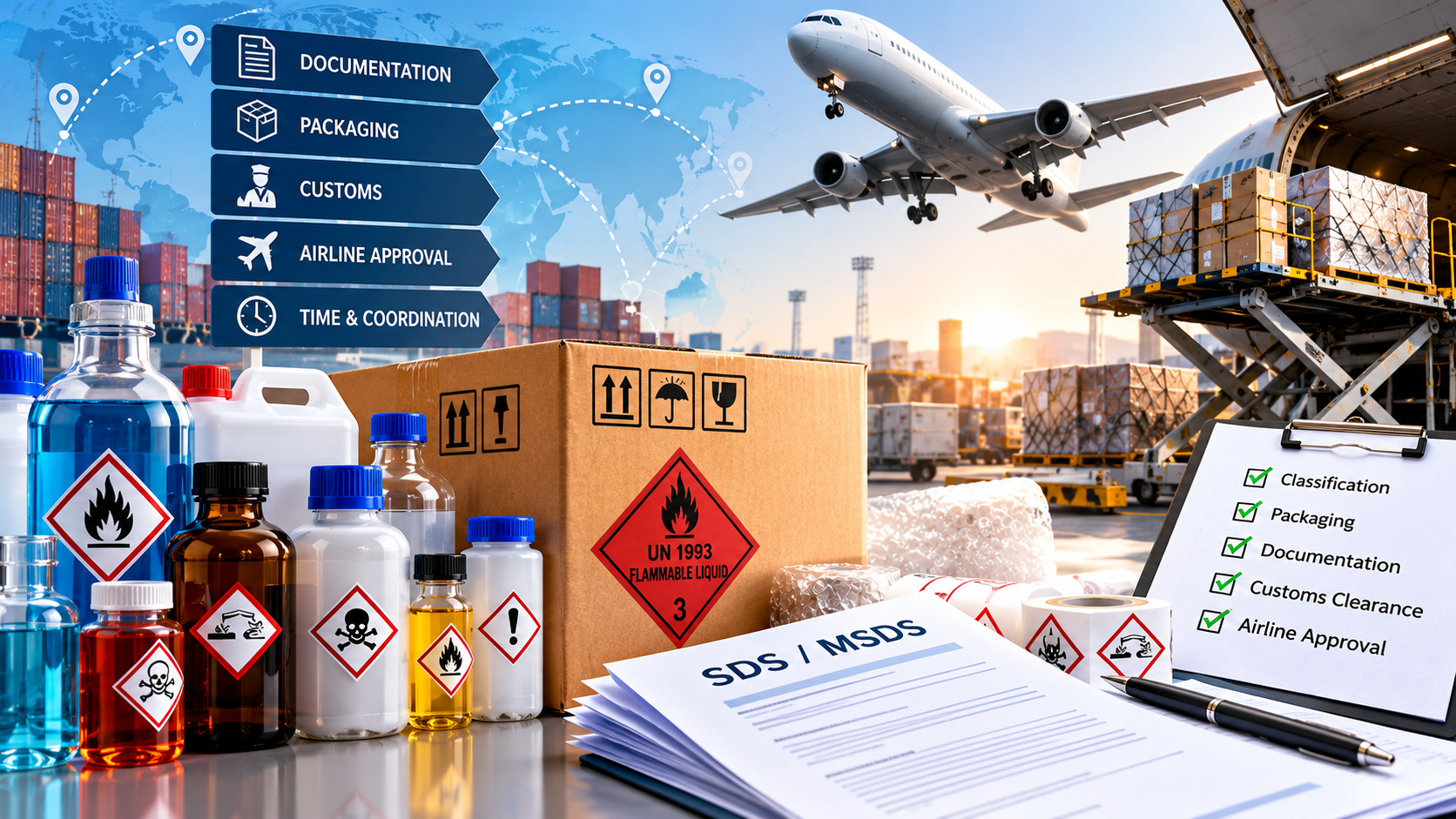
Exporting Dangerous Goods (DG) chemicals internationally involves much more than ordinary shipping. Each chemical may require proper SDS/MSDS documentation, UN classification, DG class, packing group, specialized packaging, labelling, customs clearance, and airline or carrier approval. These processes take time and careful coordination. Therefore, customers are requested to be patient with DG shipments, as safety, compliance, and proper handling must always come before speed.
Understanding Documentation, MSDS, Packaging, Customs & Airline Approvals
When a customer places an international order for chemicals, it may seem like a simple process: pack the products, hand them over to the courier or airline, and ship them to the destination.
For Dangerous Goods (DG) chemicals, however, the process is considerably more involved.
A DG shipment requires careful documentation, classification, specialized packaging, regulatory checks, customs procedures, and approval from the relevant transport provider. This is why DG chemical shipments can sometimes take longer than ordinary shipments.
At SterLab, we always request our customers to be patient during this process because every step is important for ensuring that the shipment can be transported safely and compliantly.
1. What Makes a Chemical Shipment “DG”?
Certain chemicals are classified as Dangerous Goods because they may present hazards during transportation, such as being flammable, corrosive, toxic, oxidizing, or otherwise hazardous.
Before shipping, each chemical needs to be assessed according to the applicable transport regulations.
Important information can include:
- UN Number
- Proper Shipping Name
- Dangerous Goods Class
- Packing Group, where applicable
- Quantity being shipped
- Packaging requirements
- Safety Data Sheet (SDS/MSDS)
- Mode of transportation
- Destination-country requirements
These details determine how the chemical needs to be prepared and transported.
2. Collecting the MSDS/SDS
One of the first and most important steps is collecting the correct Safety Data Sheet (SDS/MSDS) for each chemical.
The SDS provides essential information about the product, including its hazards, handling requirements, transport classification, storage conditions, and emergency procedures.
When an order contains multiple chemicals, the documentation process can become extensive because each product may have different transport requirements.
The documentation must be checked carefully before the shipment moves forward.
3. Correct Classification Is Essential
Not every chemical is handled in the same way.
Depending on the product, it may fall under a particular UN number, DG class and packing group. These classifications influence the packaging, labelling, documentation and transportation requirements.
For this reason, simply putting chemicals into a box is not sufficient.
The shipment must be prepared according to the classification applicable to the specific chemical and the transportation method being used.
4. DG Packaging Requires Special Attention
Packaging is one of the most important parts of a DG shipment.
Each chemical must be packaged according to the requirements applicable to its classification, UN number, packing group, quantity and mode of transport.
This may involve:
- Appropriate inner packaging
- Suitable outer packaging
- Leak prevention
- Absorbent or protective materials where required
- Correct closures
- Required markings and labels
- Proper segregation of incompatible materials
- Protection against damage during transportation
Packaging a DG shipment can therefore take considerably more time than packing ordinary laboratory products.
The objective is not simply to pack the product—it is to prepare it safely for transportation.
5. Documentation for Customs
International DG shipments involve customs procedures in addition to normal export documentation.
Depending on the shipment and destination, documentation may include commercial and transport documents, SDS/MSDS, DG declarations or other information required by the relevant authorities and carrier.
The documents must be accurate and consistent with the actual contents of the shipment.
Any discrepancy in the chemical name, quantity, classification, packaging or documentation can lead to additional checks or delays.
6. Airline Approval Can Take Time
When DG chemicals are being shipped by air, the process can involve additional checks by the airline or its appointed DG handling team.
The airline may need to review:
- Chemical classification
- UN number
- Packing group
- Quantity
- Packaging
- Labels and markings
- Documentation
- Applicable transport restrictions
The shipment may therefore be completely ready at the supplier's warehouse but still have to wait for airline acceptance or approval before it can be dispatched.
This is one of the main reasons a DG shipment may take longer than expected.
7. Why Customers Need to Be Patient
One of the most important things we tell our customers is:
Please be patient with DG shipments.
A delay does not necessarily mean that the order is not ready.
In many cases, the products may already be:
Manufactured → Checked → Packed → Ready for Dispatch
but the shipment may still be waiting for documentation, customs processing, carrier acceptance or airline approval.
For DG shipments, safety and compliance must come before speed.
Trying to rush the process can create unnecessary risks and may result in additional delays.
8. Every DG Shipment Requires Coordination
A successful international DG shipment can involve several parties:
Supplier → DG Packaging Team → Documentation Team → Customs → Freight Forwarder → Airline/Carrier → Destination Customs → Final Delivery
Each party has its own procedures and requirements.
A delay at any one stage can affect the overall delivery timeline.
This is why DG shipping requires coordination, communication and patience from everyone involved.
9. What Customers Can Do to Help
Customers can help make the process smoother by providing complete and accurate information at the beginning of the order.
Important information may include:
- Complete delivery address
- Importer details
- Contact information
- Required permits or approvals, where applicable
- Destination-country requirements
- Any special shipping instructions
Providing this information early can help reduce avoidable delays.
Safety First, Delivery Second
At SterLab, we understand that customers want their orders delivered as quickly as possible. We understand the urgency, especially when chemicals are required for laboratories, educational institutions, research facilities or industrial applications.
However, when an order contains Dangerous Goods, there are additional responsibilities that cannot be skipped.
The chemical must be correctly identified, documented, packaged, labelled and accepted for transportation before it can begin its journey.
A DG shipment may take more time—but every extra step has a purpose.
Our priority is to make sure the shipment is prepared properly and handed over for transportation in accordance with the applicable requirements.
Final Message to Our Customers
When you order DG chemicals internationally, please allow additional time for processing and transportation.
Behind every DG shipment there is a significant amount of work involving MSDS/SDS collection, classification, specialized packaging, documentation, customs procedures and carrier/airline approvals.
So, when we ask you to be patient, it is not simply because the shipment is delayed.
It is because we are making sure your shipment is prepared correctly before it leaves our facility.
DG Shipping Takes Time. Safety, Compliance & Proper Handling Come First.
Note: Specific requirements vary by chemical, quantity, destination, and mode of transport. DG shipments should always be prepared and offered for transport in accordance with the applicable current regulations and carrier requirements.